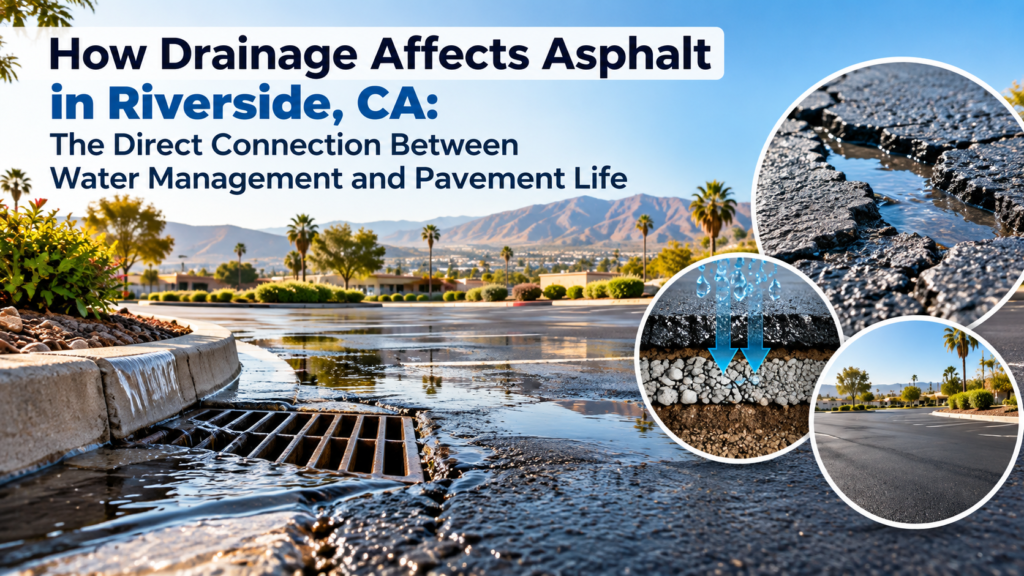
Water is asphalt’s most consequential adversary. More than traffic loading, more than UV radiation, more than the extremes of Riverside’s Inland Empire heat, it is water and specifically the management or mismanagement of water around and beneath paved surfaces that most directly determines how long asphalt lasts. This relationship between drainage and pavement life is not abstract. It is a cause-and-effect sequence with specific, observable, and largely preventable failure modes.
In Riverside, the Drainage Affects Asphalt Riverside challenge for asphalt pavement has two distinct dimensions. During the wet season roughly November through March storm events bring rain to surfaces that have been cracked and oxidized by the preceding dry months. During the dry season, irrigation systems run continuously, and the water they apply to landscape areas adjacent to pavement surfaces finds its way into the subbase through pavement edges, utility trenches, and any existing crack network. Understanding how each pathway damages pavement is essential for managing pavement effectively in this climate.
How Water Enters Asphalt Pavement
Water enters asphalt pavement through three primary pathways: surface infiltration through cracks and joints, lateral infiltration from adjacent unpaved areas or landscaping, and capillary rise from the groundwater table. Each pathway has different implications for how rapidly it damages the pavement structure and what drainage measures prevent it.
Surface infiltration through cracks is the dominant pathway for most Riverside driveways and parking lots. Once asphalt cracks from thermal cycling, traffic fatigue, or UV oxidation each crack becomes a direct conduit from the surface to the aggregate base below. A single quarter-inch crack in the surface course can admit gallons of water per storm event into the pavement structure. The water saturates the aggregate base, then the subgrade, and the weakening of these layers under load initiates the pothole-formation sequence described elsewhere.
Lateral infiltration occurs where the pavement edge is not protected no curbing, no sealed joint between asphalt and adjacent concrete, or no properly compacted aggregate shoulder. In Riverside’s residential neighborhoods, driveways that terminate at a graded landscape area without edge protection allow irrigation water and rain runoff from the yard to migrate laterally beneath the pavement at grade. This lateral migration saturates the subbase from the sides inward, producing the edge cracking and edge raveling that is common on older Riverside residential driveways.
What Saturated Subgrade Does to Asphalt Performance
The bearing capacity of soil its ability to support loads without excessive deflection decreases dramatically when the soil is saturated. For the alluvial soils common in the Riverside valley floor silty sands, sandy clays, and clayey silts the difference in bearing capacity between dry and saturated conditions can be a factor of three to five. Pavement designed to a certain structural section on a dry subgrade may be grossly inadequate when the subgrade is wet.
When a pavement section is loaded over a saturated subgrade, the deflection under each wheel pass is greater than the pavement structure was designed to accommodate. This excess deflection stretches the bottom of the asphalt layer in tension, initiating fatigue cracks that propagate upward through the layer. The progression is invisible at first the cracks are deep in the structure but once they reach the surface the pavement shows the alligator crack pattern that signals structural failure.
In Riverside’s fine-grained alluvial soils, a saturated subgrade also creates positive pore water pressure under load. The pressure of the water trapped in the soil pores under a passing wheel creates hydraulic forces that pump fine particles out of the subgrade and into the aggregate base, degrading the base gradation and reducing drainage capacity. This process called pumping accelerates over time and is one reason why pavement on saturated fine-grained subgrades fails disproportionately rapidly.
Surface Drainage Design: Why Grade Matters in Riverside Pavement
Proper surface drainage begins with proper design of the pavement surface grade. A minimum cross-slope of two percent two inches of fall per ten feet of width is the standard minimum for parking lots and driveways. This cross-slope ensures that water flows off the paved surface rather than pooling on it. Pooling water dramatically increases the volume of infiltration through surface cracks and dramatically increases the load on the subgrade through the weight and hydrostatic pressure of the standing water.
In Riverside’s hot dry climate, pavement that repeatedly ponded and then dried through the summer develops surface oxidation faster than well-drained pavement. The evaporation of ponded water leaves behind dissolved salts and fine particles that penetrate surface cracks and contribute to accelerated raveling. The combination of chemical and physical degradation at ponding locations means that areas of poor drainage in a Riverside parking lot tend to be the first areas to require repair.
Grade design for driveways on sloped Riverside properties requires attention to both the cross-slope (directing water off the paved width) and the longitudinal slope (managing the velocity of water running down the driveway). On steep Riverside foothills driveways, runoff velocities can erode the driveway edge and the subbase at the low end of the slope. Trench drains or cross-drains at strategic intervals intercept and redirect this runoff before it erodes the pavement structure.
The Role of Curbs and Gutters in Protecting Riverside Pavement
Curbs and gutters are not merely aesthetic elements of street design. They serve the essential function of collecting surface runoff and directing it to storm drain inlets, preventing it from infiltrating the pavement subbase at the pavement edge. Sections of Riverside streets and commercial properties without proper curbing show disproportionately high rates of edge deterioration because the pavement edge is unconfined and exposed to lateral water infiltration.
Curb and gutter systems that are cracked, settled, or separated from the adjacent pavement at the joint allow water to bypass the drainage system and infiltrate directly into the pavement subbase at the curb-gutter-pavement joint. This joint is one of the most critical waterproofing details in pavement construction, and its failure from tree root intrusion, thermal movement, or vehicular impact creates a concentrated water infiltration pathway that can undermine pavement sections adjacent to the curb even when the pavement surface appears otherwise intact.
Irrigation Overspray: The Overlooked Drainage Problem in Riverside
Riverside’s warm climate means irrigation systems operate year-round, and the impacts of irrigation on adjacent pavement receive less attention than rainfall drainage but can be equally damaging. The mechanisms are the same: water infiltrating through cracks and at pavement edges saturates the subbase and weakens the subgrade. The difference is that irrigation delivers water continuously during the growing season rather than in discrete storm events.
Commercial properties in Riverside are particularly vulnerable. Parking lot perimeter landscaping, median planters, and street tree irrigation systems all apply water adjacent to and sometimes directly onto pavement surfaces. Rotary sprinkler heads that are not properly adjusted to irrigate only the planted area spray water across adjacent asphalt repeatedly. Drip irrigation systems with broken emitters or improperly installed pressure compensating equipment can create saturated soil zones adjacent to pavement for extended periods.
The fix for irrigation-related pavement damage is a combination of irrigation system audit and adjustment ensuring spray heads are not reaching pavement, drip systems are not over-applying water and proper pavement edge sealing and drainage design that prevents lateral migration of irrigation water into the subbase.
Frequently Asked Questions: Drainage and Asphalt in Riverside
What is the minimum slope required for parking lot drainage in Riverside?
Two percent cross-slope two inches of fall per ten feet of width is the standard minimum. Steeper slopes may be needed in flat areas where drainage to collection points requires additional grade.
How does irrigation affect asphalt in Riverside differently than rain?
Irrigation applies water continuously during the growing season rather than in discrete events. This sustained moisture application through pavement edges and cracks keeps subgrade soils wetter for longer periods than rainfall alone, progressively reducing subgrade bearing capacity.
Why do pavement edges deteriorate faster than pavement centers in Riverside?
Edges lack lateral confinement and are exposed to lateral water infiltration from adjacent unpaved areas or landscaping. Without curbing or sealed edge joints, water migrates beneath the pavement from the side, saturating the subbase inward from the edge and initiating edge cracking.
Can a drainage problem be fixed without replacing the pavement?
Sometimes. If the drainage deficiency is at the surface improper grade, blocked inlets, or lack of edge sealing correcting it can prevent further damage without requiring pavement replacement. If the subbase is already saturated and the pavement structurally compromised, drainage correction alone does not restore the lost bearing capacity; base repair or replacement is also required.
What happens to asphalt when water gets under it?
Saturated subgrade loses bearing capacity. Under traffic loading, the pavement deflects excessively, fatiguing the asphalt layer from the bottom up. Fine particles in the subgrade pump upward into the aggregate base, further degrading drainage and load distribution. The end result is alligator cracking at the surface followed by pothole formation.
Drainage is not a peripheral issue in Riverside asphalt maintenance it is central. Every pavement investment is worth more when the drainage around and beneath the pavement is managed well: water kept off the surface, away from the edges, and out of the subbase. Every dollar spent on grading, sealing, and curbing to manage water around pavement extends the life of the pavement investment and defers the much larger cost of structural repair or replacement.